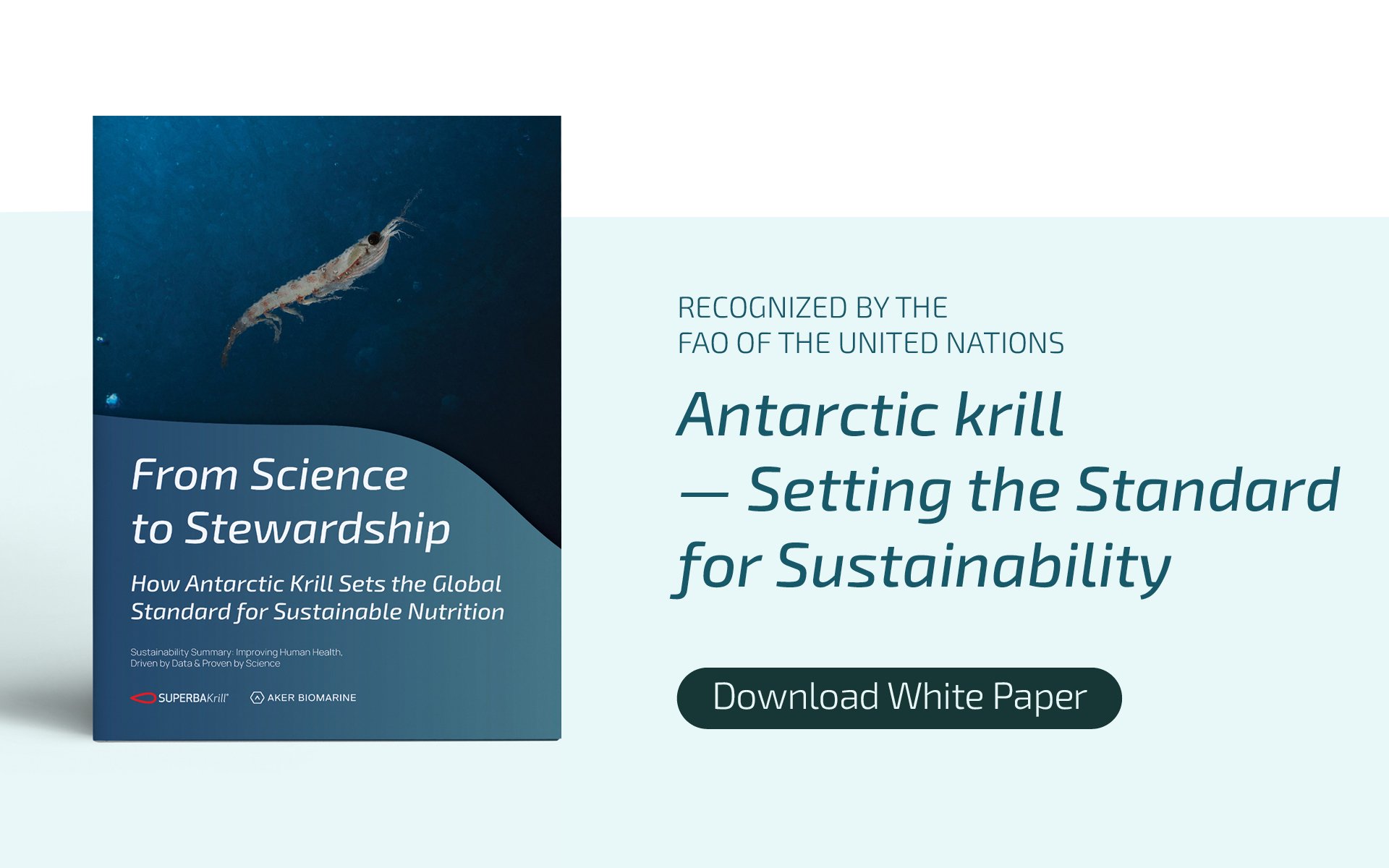
New data show thriving krill and whale populations – and a fishery designed to protect both.
As global delegates gather in Hobart for the annual CCAMLR meeting on the management of the Antarctic ecosystem, new research from the Norwegian Institute of Marine Research (IMR) confirms strong and stable Antarctic krill stocks alongside growing whale populations.
Aker BioMarine, the largest industrial operator in the region, has long expressed its support for stronger conservation measures, including a proposal for what could become one of the world’s largest marine protected areas around the Antarctic Peninsula - a hotspot for wildlife activity.
“It’s encouraging to see whale populations recovering while the krill population remains stable — that tells us the ecosystem is in good balance,” said Matts Johansen, CEO of Aker BioMarine.
IMR has run annual krill surveys around South Orkney since 2011 and have never detected a higher krill biomass in the area than in 2025.
Record Krill Populations
IMR’s annual surveys around South Orkney, conducted since 2011, show that 2025 recorded the highest krill biomass in the area ever observed.
“Krill are masters of reproduction — a single female can lay up to 10,000 eggs at a time,” explained Johansen. “Most krill die from starvation, which shows just how vast the population truly is. Still, we must avoid undue interference with wildlife. That’s why the industry has implemented voluntary marine protection zones, for example during penguin breeding season, and why we’re promoting one of the world’s largest marine protected areas around the Antarctic Peninsula — precisely where wildlife is most concentrated.”
Science-Based Approach Marine Protection
The Antarctic krill fishery is managed under the Commission for the Conservation of Antarctic Marine Living Resources (CCAMLR), which enforces strict catch limits, real-time monitoring, and voluntary spatial closures to protect sensitive wildlife areas.
Aker BioMarine led an industrywide effort in 2019 to establish a voluntary marine protected zone to safeguard penguin colonies during breeding season. This measure continues to support the creation of a large-scale marine protected area around the Antarctic Peninsula, home to most the region’s wildlife.
The ongoing CCAMLR negotiations will shape how marine protection is implemented across Antarctica. Aker BioMarine’s position is clear: industry and nature must thrive together.
Global Science Confirms Sustainable Management
Independent research backs this science-led approach. The IUCN Red List classifies Euphausia superba (Antarctic krill) as ‘Least Concern’, with a stable population trend. Meanwhile, whale monitoring programs across the Southern Ocean report strong increases in humpback and fin whale populations — clear indicators of a healthy, resilient ecosystem.
The UN Food and Agriculture Organization (FAO) recently recognized Antarctica as the only ocean region in the world where all assessed fisheries are managed sustainably, according to its 2025 Review of the State of World Marine Fishery Resources. This underscores that the Antarctic krill fishery remains both ecologically sound and a global model for responsible ocean management.
“It’s positive to see both krill and whale populations thriving as the world debates the next steps for marine protection,” added Johansen. “Our industry depends on a healthy ecosystem, and we’re ready to support ambitious protection measures that ensure Antarctica remains the best-managed ocean region in the world.”